The Inaction Liability: How Commercial Silence Permanently Erodes UK Business Contract Rights

In commercial life, the instinct to preserve a working relationship often overrides the impulse to enforce contractual rights. A supplier delivers late again; a tenant pays rent a week beyond the due date; a service provider repeatedly misses agreed performance benchmarks. The business owner says nothing, preferring to maintain goodwill rather than raise a formal complaint. It feels pragmatic. In many cases, it is catastrophic.
English contract law does not regard silence as neutral. Under the doctrine of acquiescence — and its close relative, waiver by conduct — a pattern of unchallenged breaches can fundamentally alter the legal character of an agreement. Rights that were clearly established at the point of signing may become unenforceable, not because they were negotiated away, but because they were quietly abandoned through inaction.
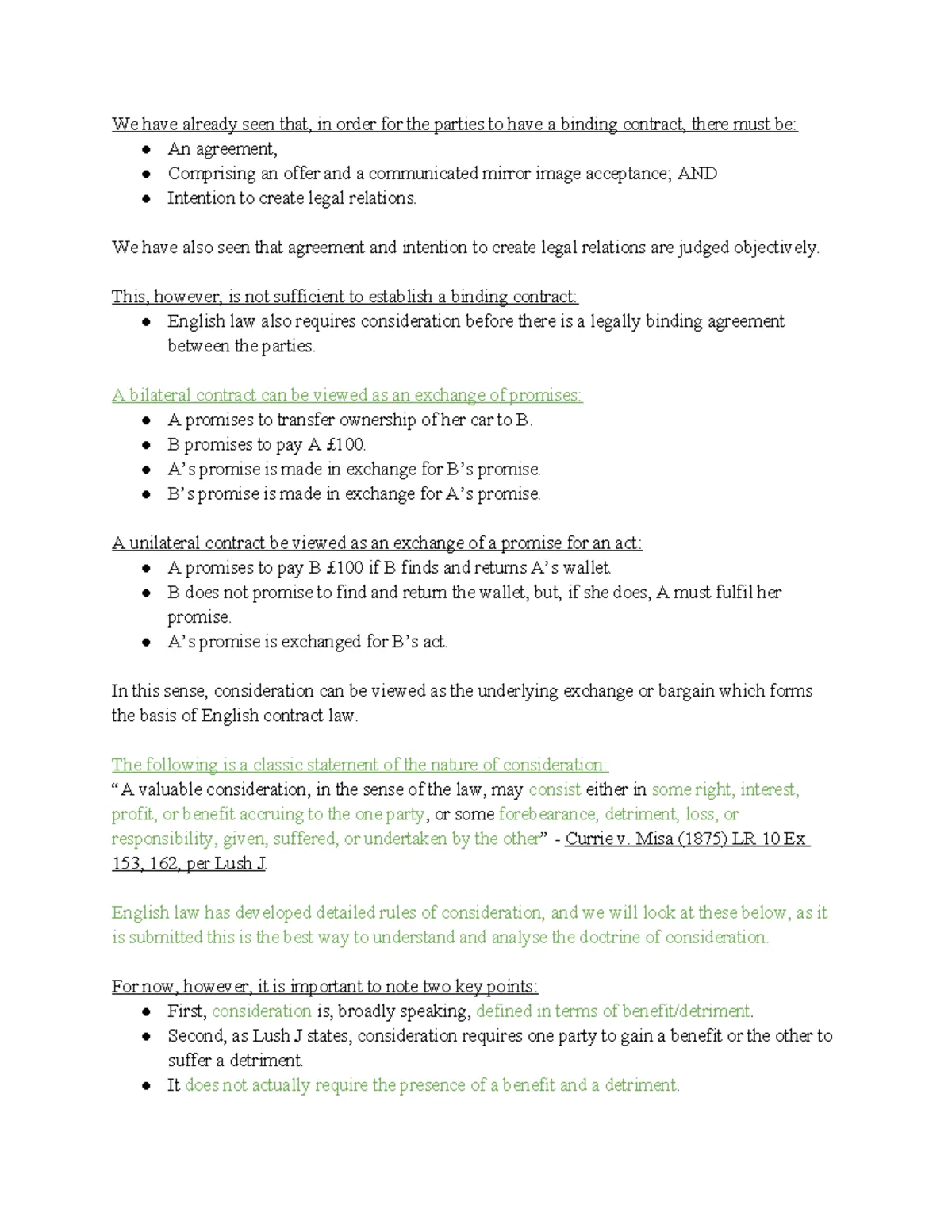 Photo: English contract law, via website-assets.studocu.com
What Acquiescence Actually Means in Practice
Acquiescence, in its contractual context, occurs when a party with knowledge of a breach chooses not to act upon it, and that choice is sufficiently consistent and prolonged that a court concludes they have implicitly accepted the altered state of affairs. The doctrine is closely related to estoppel — specifically promissory or equitable estoppel — which prevents a party from enforcing a right when the other party has reasonably relied upon conduct suggesting that right would not be exercised.
Consider a commercial lease requiring rent to be paid on the first of each month. If a landlord consistently accepts payment on the fifteenth without objection across twelve consecutive months, a court may well conclude that the tenant has been led to believe the original payment date is no longer strictly enforced. Attempting to forfeit the lease or claim breach based on lateness thereafter becomes considerably more difficult.
The same principle applies across a wide range of commercial relationships: supply agreements, distribution contracts, service level arrangements, and licensing deals. Wherever one party holds a contractual right and repeatedly fails to assert it in the face of non-compliance, the foundations of that right begin to erode.
The Commercial Relationship Dilemma
It would be naive to suggest that businesses should respond to every minor breach with formal legal correspondence. Commercial relationships are built on flexibility, trust, and the understanding that rigid enforcement can destroy more value than it protects. The difficulty is that most business owners do not appreciate where the line falls between reasonable commercial flexibility and legally consequential acquiescence.
The courts do not require a single act of tolerance to constitute waiver. In most cases, a pattern of conduct must be established. However, the threshold varies depending on the nature of the right in question, the duration of the non-enforcement, and whether the other party demonstrably relied upon the apparent accommodation. There is no fixed formula. This ambiguity is itself a source of significant risk.
What makes the situation particularly dangerous for UK businesses is that the erosion of rights often goes undetected until the moment enforcement becomes commercially necessary — typically when the relationship breaks down or when the counterparty's financial position deteriorates. By that stage, the legal landscape may have shifted materially against the party seeking to rely on the original contractual terms.
Preserving Rights Without Destroying Relationships
Fortunately, there are well-established mechanisms through which businesses can accommodate commercial flexibility whilst preserving their formal legal position. The most effective of these is the reservation of rights notice — a brief written communication, typically issued alongside any act of accommodation, that makes clear the accommodation is exceptional and does not constitute a waiver of the underlying contractual right.
Such a notice need not be adversarial in tone. It can be framed simply as a matter of procedural housekeeping, noting that whilst the business is content to accept late payment on this occasion, it reserves all rights under the agreement and does not intend for this to set a precedent. Delivered consistently and proportionately, such communications protect the legal position without signalling hostility.
Many businesses also benefit from incorporating explicit non-waiver clauses within their standard contract terms. These provisions state that any failure or delay in exercising a right shall not constitute a waiver of that right. Whilst such clauses are not absolute — courts retain discretion and can find waiver by conduct notwithstanding a non-waiver clause in sufficiently clear cases — they provide a meaningful additional layer of protection.
Periodic contractual reviews are equally important. Where a pattern of accommodation has already developed, it may be possible to reset the position through a formal written communication to the counterparty, confirming that the agreement will henceforth be enforced strictly in accordance with its terms and that previous flexibility should not be taken as indicative of future practice. This does not retrospectively restore rights that have already been lost, but it can prevent further erosion.
The Role of Contemporaneous Records
Documentation is, in this context, a risk management tool of the first order. Businesses that maintain clear records of when and why accommodations were granted — and crucially, that those accommodations were granted as exceptions rather than accepted as the new norm — are far better positioned to resist acquiescence arguments if disputes arise.
Email correspondence is particularly valuable. An informal message acknowledging a late delivery but noting that the agreed schedule remains in force creates a contemporaneous record that directly contradicts any suggestion of tacit consent. In litigation, such records can be decisive.
The Broader Strategic Implication
The acquiescence trap is not merely a legal technicality. It reflects a broader truth about commercial risk management: that the terms of a contract do not exist solely in the written document, but are continuously shaped by the conduct of the parties throughout the relationship. A business that actively manages that conduct — through reservation of rights notices, clear internal policies on breach response, and regular legal review of commercial arrangements — occupies a fundamentally stronger position than one that allows relationships to drift.
For UK businesses operating in an increasingly complex commercial environment, the cost of professional advice on contract management is invariably modest compared with the cost of discovering, at the worst possible moment, that rights assumed to be intact were quietly surrendered months or years earlier.
AC Norris Advisory works with clients across the UK to identify and address contractual vulnerabilities before they crystallise into material liabilities. If your business has commercial relationships where performance has been inconsistent and formal objection has been absent, a structured review of your legal position is a prudent and necessary step.