Pension Deficit Roulette: The Defined Benefit Time Bomb Hidden Inside UK Business Acquisitions

Among the many risks that accompany the acquisition of an established UK business, few carry the potential for long-term financial devastation comparable to an inherited defined benefit pension scheme. These legacy arrangements — once commonplace across British industry and the public sector supply chain — promise retiring employees a guaranteed income based on their final salary or career average earnings. The employer bears the investment risk entirely. And when the investment assumptions embedded in the scheme's actuarial model prove optimistic, it is the acquiring business that bears the consequences.
The asymmetry between the apparent cost at the point of acquisition and the true long-term obligation has caught numerous experienced buyers off guard. A scheme that presents a modest deficit on the transaction balance sheet can evolve into an existential commercial burden within a matter of years, driven by factors entirely outside the acquirer's control.
Why Pension Liabilities Are Routinely Underestimated
The valuation of a defined benefit pension scheme liability is not a straightforward accounting exercise. It depends on a series of actuarial assumptions — projected investment returns, life expectancy improvements, inflation rates, and discount rates — each of which introduces material uncertainty. The figure disclosed during a transaction reflects a snapshot assessment under assumptions that may prove substantially incorrect over the scheme's remaining life.
Discount rates are particularly significant. The liability is calculated as the present value of future benefit payments, and the discount rate applied to those future cash flows has an enormous effect on the headline deficit figure. A relatively modest reduction in the discount rate — driven, for example, by falling gilt yields — can increase the reported deficit by tens of millions of pounds. The period following the 2008 financial crisis and the subsequent decade of historically low interest rates produced precisely this effect, dramatically expanding deficits that had previously appeared contained.
Life expectancy assumptions present a similar challenge. Actuarial projections have consistently underestimated improvements in longevity, meaning that schemes have been paying benefits for longer than their funding models anticipated. Each revision to mortality tables increases the scheme's liabilities retroactively, without any corresponding increase in assets.
Buyers who rely solely on the scheme's most recent actuarial valuation — which may itself be several years old by the time of the transaction — are therefore working from information that has limited predictive value.
The Regulatory Framework and Its Implications
The Pensions Regulator exercises considerable authority over the management of defined benefit schemes, and acquirers should understand the regulatory landscape before completing any transaction involving a legacy scheme.
 Photo: The Pensions Regulator, via sageaccountssolutions.co.uk
Under the Pensions Act 2004, scheme trustees are required to agree a funding plan with the sponsoring employer, aimed at eliminating any identified deficit over a recovery period typically not exceeding ten years. Where the sponsoring employer changes hands, trustees may use the occasion to renegotiate the recovery plan — potentially demanding accelerated deficit contributions that the acquirer had not anticipated.
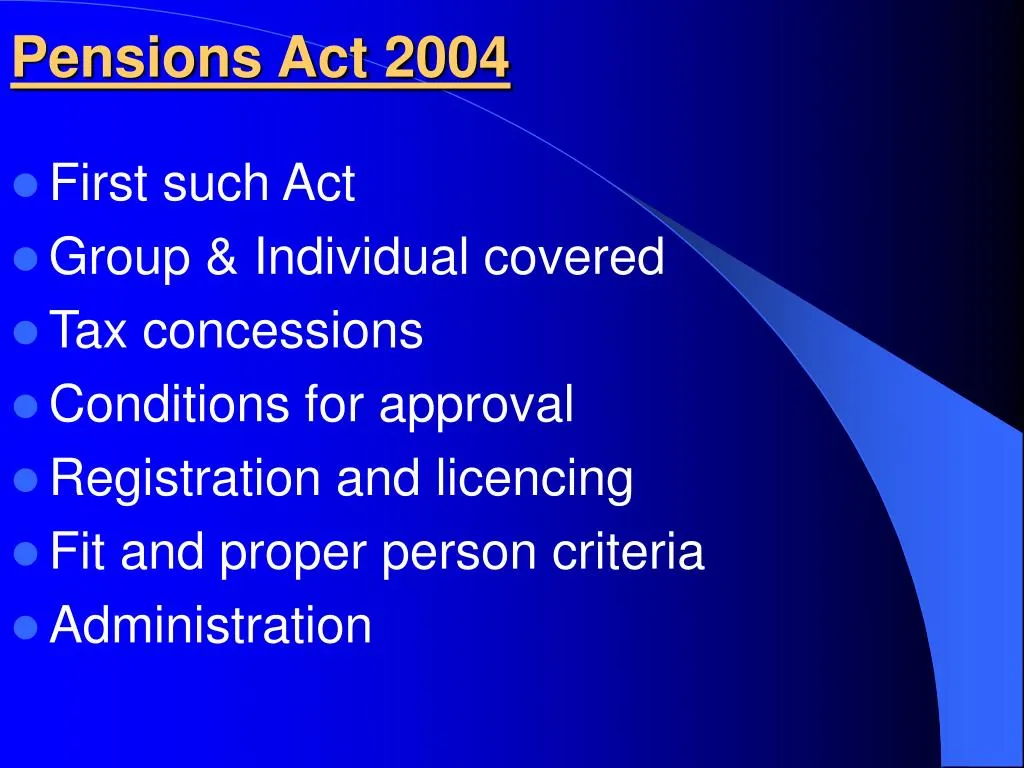 Photo: Pensions Act 2004, via image2.slideserve.com
Furthermore, The Pensions Regulator holds powers under the moral hazard provisions of the legislation to issue contribution notices and financial support directions to parties connected with or associated with a scheme employer. These powers extend beyond the immediate corporate entity to group companies and, in certain circumstances, to individuals involved in the transaction. An acquirer that restructures the target business in a manner that weakens the covenant supporting the scheme may find itself subject to regulatory intervention.
The introduction of the scheme funding code — which has been subject to ongoing reform — has also raised the bar for scheme funding standards, with implications for the recovery plans that schemes may be required to pursue.
Due Diligence Deficiencies
The frequency with which pension liabilities are underestimated during acquisitions reflects genuine deficiencies in the due diligence process rather than any deliberate concealment. Buyers typically commission a desktop review of the most recent actuarial valuation and scheme accounts, supplemented by legal due diligence on the scheme's governing documentation. This level of analysis is frequently insufficient.
What is often absent is an independent actuarial assessment of the scheme's liabilities under current market conditions, stress-tested against plausible adverse scenarios. The cost of commissioning such analysis is modest relative to the potential exposure; yet it remains routinely omitted from deal timelines under commercial pressure to close quickly.
The quality of information provided by sellers also varies considerably. A seller motivated to achieve a clean exit may present scheme information in a format that emphasises the most favourable interpretation of the liability position. Trustees, who have independent obligations to scheme members, may provide a rather different perspective — but they are not always accessible to prospective buyers prior to completion.
The interaction between the pension liability and the wider transaction structure warrants particular attention. Where a buyer acquires a business through a share purchase, it inherits the employer's obligations to the scheme in their entirety. An asset purchase, by contrast, may allow the buyer to leave pension liabilities with the seller — though this requires careful structuring and does not eliminate all regulatory risk.
Negotiation Strategies and Structural Protections
For buyers who identify material pension exposure during due diligence, several protective mechanisms are available, provided they are pursued with sufficient rigour before the transaction completes.
Price adjustment mechanisms linked to the scheme's funding position at completion — rather than at the date of the most recent actuarial valuation — provide a degree of protection against deterioration during the transaction period. Sellers will resist these provisions, but they are not uncommonly agreed in transactions involving material scheme liabilities.
Specific indemnities covering pension-related regulatory action, trustee claims arising from pre-completion conduct, and the costs of any enhanced recovery plan imposed post-completion should be sought as standard. The scope and duration of these indemnities — and the financial capacity of the seller to honour them — require careful evaluation.
In larger transactions, buyers have successfully negotiated the de-risking of schemes prior to completion, through mechanisms such as a bulk annuity purchase that transfers longevity and investment risk to an insurer. Whilst expensive, this approach eliminates the ongoing uncertainty associated with an open liability.
Managing Inherited Obligations
For buyers who have already completed a transaction and are managing an inherited scheme, the priorities are somewhat different. Early engagement with trustees — conducted in a spirit of genuine collaboration rather than adversarial negotiation — typically produces better outcomes than a confrontational approach. Trustees have significant leverage under the regulatory framework, and a relationship of mutual trust facilitates more flexible recovery plan discussions.
Regular actuarial monitoring, integrated with the business's wider financial planning cycle, is essential. The scheme's funding position should be treated as a live commercial variable, not a static figure revisited only at triennial valuation.
Where the business faces financial difficulty, early engagement with The Pensions Regulator — before any restructuring action is taken — substantially reduces the risk of regulatory intervention that could complicate or prevent an otherwise viable recovery plan.
Defined benefit pension obligations do not diminish through neglect. They demand the same rigorous management as any other significant financial liability — and, in the context of an acquisition, they demand thorough investigation before a single pound changes hands.